Yuexiu Park
The City's Largest Central Park & The Legend of the Five Rams
Overview
Yuexiu Park is basically Guangzhou's backyard and history museum rolled into one massive green space. As the largest central park in downtown, it's impossible to separate from the city's identity. The iconic Five Rams Sculpture lives here—it's literally the symbol of Guangzhou, which is why you'll hear people call this place the "City of Rams." But that's not all. The park also has this absolutely stunning preserved section of the ancient Ming Dynasty City Wall, where tree roots have grown through the bricks in the most photogenic way possible. It's nature, culture, and history all layered together, and honestly, I kept finding reasons to come back.
At over 860 acres, this place is HUGE. I thought I'd cover it in a couple hours and ended up walking over 15,000 steps without even realizing it. What I love most is how it serves two completely different purposes simultaneously—it's where locals come to exercise, dance, and socialize every morning, but it's also a serious historical site that preserves the legendary origins of the city. The name "Yuexiu" (越秀) means "surpassing elegance," and yeah, that sounds fancy, but after spending time here, I totally get it.
The landscape follows traditional Chinese garden principles with carefully arranged hills, lakes, pavilions, and ancient trees. But it's not stuffy or museum-like. There are modern amenities everywhere, families having picnics, kids running around—it's alive. That blend of old and new is exactly what Guangzhou is all about, and this park captures it perfectly.
Essential Info
- Hours: 06:00 - 22:00
- Tickets: Fully free to enter the park (small fee of approx. 10 RMB for Zhenhai Tower/Guangzhou Museum inside).
- Transport: Take Metro Line 2 directly to "Yuexiu Park Station" (Exit B1).
💡 Local Pro-Tip
Here's my number one piece of advice: set your alarm and get here between 7:00 and 9:00 AM. I know, I know, vacation mornings are sacred. But trust me on this. You'll see hundreds of elderly locals practicing Tai Chi with these incredibly graceful movements, groups playing Jianzi (shuttlecock) with skills that will make your jaw drop, and even people singing traditional Cantonese Opera under the ancient banyan trees. It's the most authentic glimpse into local life you'll get anywhere in Guangzhou. And whatever you do, don't miss the Ming Dynasty walls where massive tree roots have literally swallowed the ancient bricks. I spent thirty minutes photographing one section because the contrast between human history and nature's persistence was just so powerful. Bring a wide-angle lens if you have one.
The Legend of the Five Rams
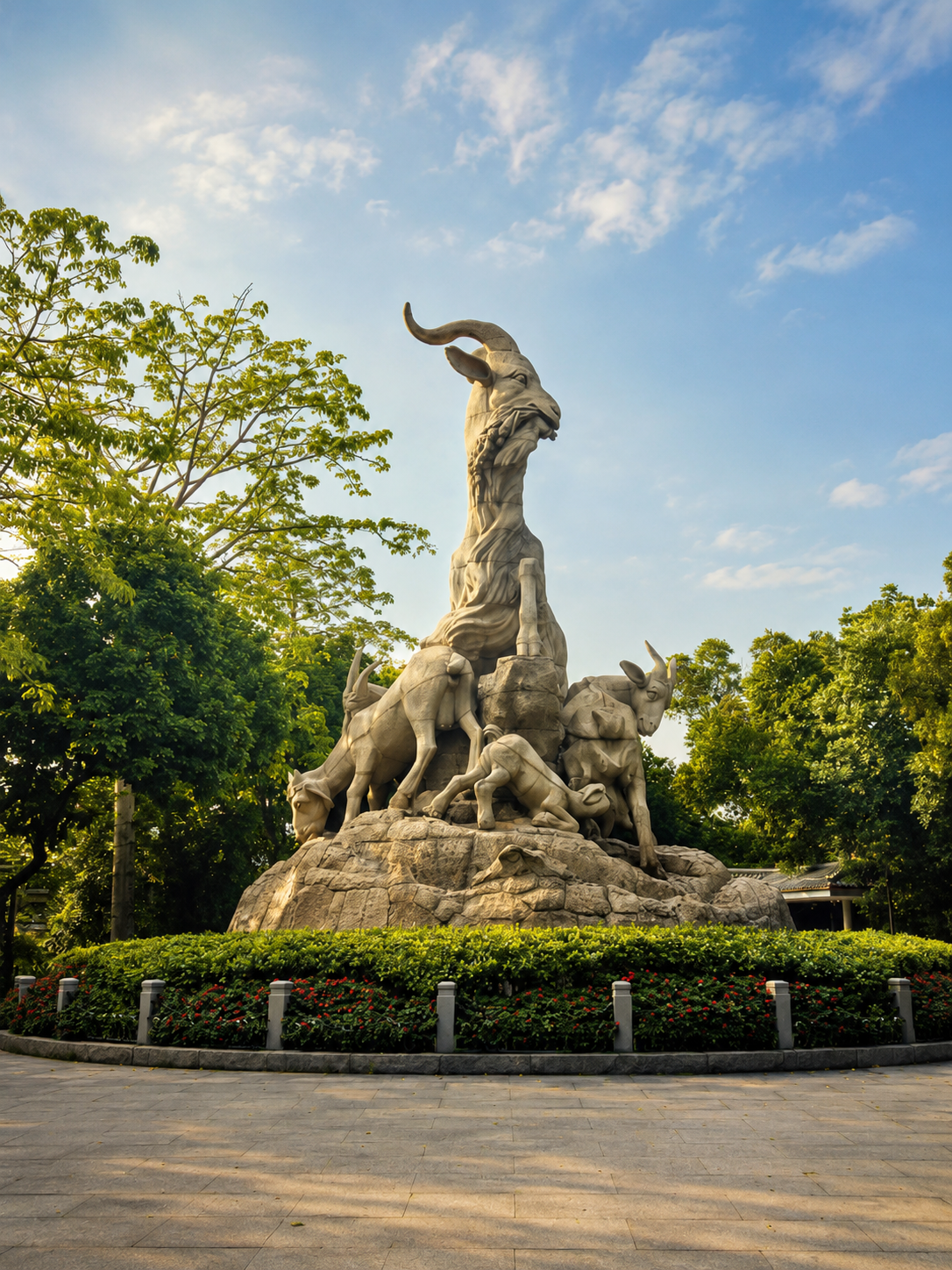
The Five Rams Sculpture (五羊雕像) is probably the most photographed thing in this entire park, and honestly, it deserves the attention. According to legend—and I heard this story from a local who swore his grandmother told it exactly the same way—over 2,000 years ago, five celestial beings rode into Guangzhou on five rams. They carried sheaves of rice in their mouths, planted them in the city, and ended a devastating famine. Basically, they brought prosperity to the land when people needed it most.
That's why Guangzhou is called the "City of Rams" or "Yangcheng" (羊城). The legend says the five rams turned to stone so they could stay and watch over the city forever. The sculpture itself was erected in 1960, and it's genuinely beautiful—five rams gathered around a rice sheath, each with a different expression and posture. A local art teacher told me they symbolize prosperity, happiness, peace, harmony, and longevity. Standing there looking up at them, I felt this weird connection to thousands of years of people who've done the exact same thing.
The sculpture has become a natural meeting point for locals and tourists alike. I went at sunrise on my second visit, and the golden light hitting that bronze against the blue sky was so striking I just stood there for a while. Sometimes the most popular spots are popular for a reason.
Ancient Ming Dynasty City Wall
This wall was honestly one of my favorite things in the entire park. Built in 1370 during the Hongwu Emperor's reign, it once protected the northern part of ancient Guangzhou. About 200 meters of the original wall still stands, and walking alongside it, you can feel the weight of those centuries. The granite blocks are massive, the battlements and watchtowers are still clearly defined, and there's this sense that you're touching something that has witnessed the entire modern history of the city.
But here's what makes it truly special: nature has absolutely reclaimed parts of this structure. Massive tree roots have grown through and around the ancient bricks, creating this incredible visual contrast between human engineering and natural persistence. I must have taken a hundred photos of the roots wrapping around the stones. It feels like a metaphor for Guangzhou itself—history and nature intertwined, neither giving way to the other.
You can walk along portions of the wall and even climb up for panoramic park views. I went in autumn when the surrounding trees had turned golden, and the contrast between the warm foliage and the gray ancient stones was just perfect. Even if you're not a history buff, this spot is worth your time. It's beautiful, it's photogenic, and it's genuinely moving.
Zhenhai Tower and Guangzhou Museum
Zhenhai Tower (镇海楼) is this gorgeous five-story pagoda built in 1380, right in the middle of the park. Originally it was a watchtower to guard against pirates, which I find completely wild—imagining pirates sailing up the Pearl River and this tower being the early warning system. Today it houses the Guangzhou Museum, which walks you through the city's 2,000-year history with artifacts, exhibits, and multimedia displays that actually kept my attention way longer than I expected.
The tower itself is stunning—traditional Chinese wooden structure with those iconic upturned eaves that I never get tired of photographing. Each level has different exhibits, ranging from ancient artifacts to surprisingly engaging displays about modern Guangzhou. But honestly? The top floor is where it's at. The panoramic views of the park and the surrounding city are worth the climb alone. I sat up there for a solid twenty minutes just taking it all in.
Admission is only about 10 RMB, which is basically nothing for what you get. The museum runs from 9:00 AM to 5:30 PM, with last entry at 5:00 PM. I almost missed the cut-off because I was so engrossed in the park, so learn from my near-mistake and give yourself plenty of time.
Early Morning Activities
I know I keep harping on about the early morning, but seriously, this is when the park becomes magic. Between 7:00 and 9:00 AM, Yuexiu Park transforms into this living cultural showcase that no tourist attraction could ever replicate. Here's what you'll see:
- Tai Chi: Groups of elderly residents moving through synchronized Tai Chi sequences with this incredible grace and precision. I tried to follow along from a distance once and felt like a clumsy giraffe, but they were so welcoming and encouraging.
- Jianzi (Shuttlecock): This weighted shuttlecock game looks simple until you see someone keep it in the air for fifty kicks using every part of their body except their hands. The skill level is honestly mind-blowing.
- Cantonese Opera: Amateur singers gather to practice traditional arias, and even though I couldn't understand the words, the emotion in their voices gave me chills. One woman noticed me listening and gave me the most beautiful smile between songs.
- Calligraphy: Artists practicing brush painting on the pavement with water, creating these gorgeous characters that slowly evaporate. It's art that exists only in the moment, and there's something deeply poetic about that.
- Dancing: Folk dance groups performing traditional routines with such joy and energy. I saw one group where the youngest member was probably seventy, and they were having the time of their lives.
These aren't performances for tourists—they're living traditions passed down through generations. Visitors are welcome to watch, and if you're feeling brave, some groups will even let you join in. Just be polite, ask first, and respect that this is their daily routine, not a show put on for your entertainment. I watched from a respectful distance and felt genuinely honored to witness it.
Best Times to Visit
Early Morning (6:00-9:00): I've said it before and I'll say it again—this is THE time. The local activities, the soft morning light, the relative quiet before the day really gets going. If you're a photographer, the light during this window is absolutely perfect.
Late Afternoon (16:00-18:00): Golden hour hits the Five Rams Sculpture and city wall in the most beautiful way. I did a late afternoon walk specifically for photos and came away with shots I'm genuinely proud of.
Spring (March-May): The park explodes with blooming flowers and lush greenery. I visited in April and the azaleas were everywhere. It felt like the whole park was celebrating.
Autumn (October-November): Perfect weather and the foliage creates these stunning color contrasts with the ancient architecture. The city wall surrounded by golden leaves is a sight I'll never forget.
Practical Tips
- Comfortable Shoes: This park is massive and the terrain varies. I wore my most supportive sneakers and still felt it in my feet by the end. Don't even think about heels or flimsy sandals.
- Water and Snacks: Bring more water than you think you need. Refreshment stands exist but they're scattered, and Guangzhou humidity is no joke. I packed snacks too because wandering around for hours works up an appetite.
- Sun Protection: Sunscreen, hat, maybe a small umbrella for shade—whatever your sun protection strategy is, bring it. Parts of the park are quite exposed and the Guangzhou sun doesn't mess around.
- Camera: You'll want it for the Five Rams, the city wall, and definitely the morning activities. I also recommend bringing a portable charger because I drained my battery twice in one visit.
- Respect: During the morning activities, keep your voice down and maintain a respectful distance. These are serious cultural practices for the people doing them, not entertainment for tourists. I saw someone get too close with a camera flash once and the group politely but firmly asked them to step back. Don't be that person.
Nearby Attractions
One of the best things about Yuexiu Park is its central location. You're close to so much more:
- Beijing Road: The historic pedestrian shopping street is only about 1km south. I walked there after my park visit and it made for a perfect day.
- Chen Clan Ancestral Hall: A traditional architecture museum that's nearby and absolutely worth adding to your itinerary. The detail in the carvings is unreal.
- Guangzhou Museum: Located within Zhenhai Tower right in the park, so you've technically already got this one covered.
- Shamian Island: The colonial architecture district is easily accessible by metro. I did this as an afternoon follow-up to my morning park visit and the contrast was fascinating.